


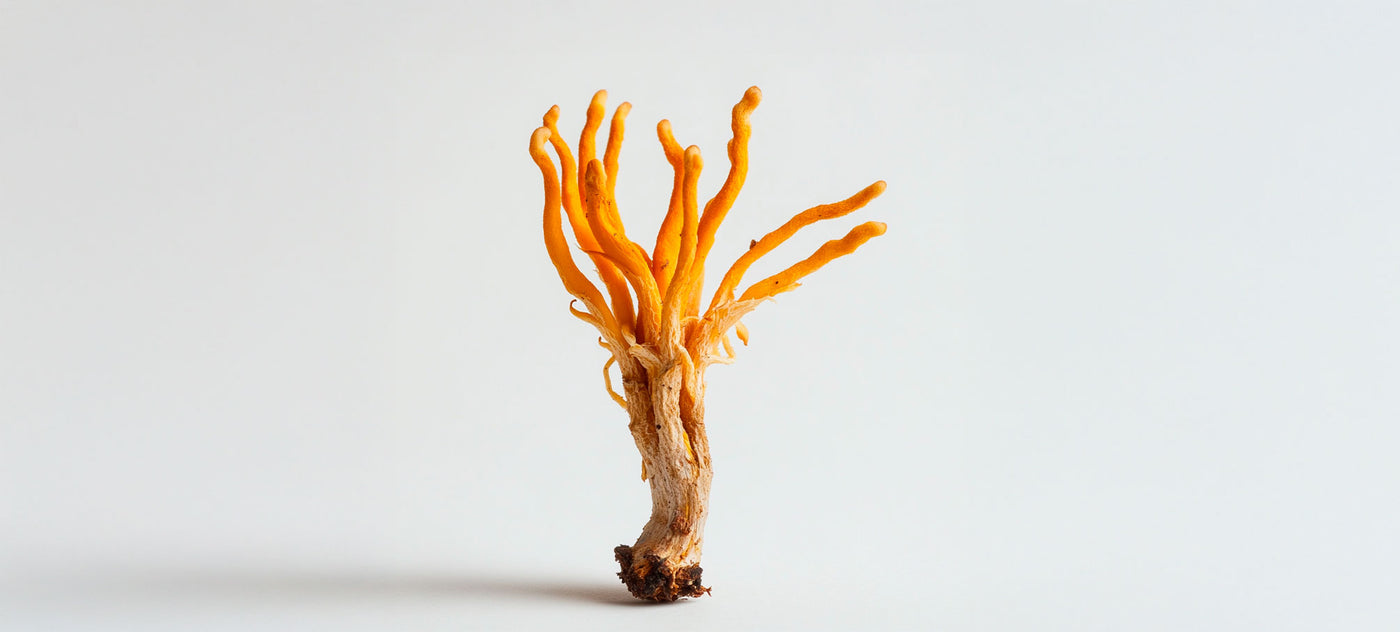

ESSENTIAL NOTES ABOUT THIS MUSHROOM
Cordyceps is a well-known functional mushroom that naturally contains compounds such as beta-glucans, ergosterol (provitamin D), essential amino acids, and linoleic and linolenic acids. It is particularly characterised by its cordycepin content, along with cordycepic acid and adenosine. Its many traditional uses as a food in Asia have led the scientific community, and our own R&D team in particular, to study it in depth.

HOW CORDYCEPS IS CONSUMED
C. sinensis is not a common mushroom that can be eaten like Boletus or Shiitake. Like Reishi or Chaga, it is mainly consumed as a concentrated extract (as in the food supplement Mico-Cord or in Hifas-Vitality) and ground, as it is very hard. Traditionally, it is used to season soups and meat fillings or added to stews and vegetable dishes.
Quality and purity
Like other pure mushroom powders, Cordyceps powder (Cordyceps Vital) can also be prepared as an infusion or added to smoothies. Extracts concentrate the mushroom's characteristic compounds and can be obtained with sustainable technologies that do not denature them. This is the case of HIFAS-Equilibrium, which contains pure biofermented C. sinensis extract, among other species.
Products with Cordyceps
-


Cordyceps Vital Powder Superfood
THE BENEFITS OF THE ENERGY MUSHROOM
24,80 €Unit price /Unavailable -

 BESTSELLERSHasta - 10 %


CORDYCEPS CULTIVATION
Thanks to scientific research, a specific strain of Cordyceps can be cultivated in a bioreactor. This system allows it to be grown on a natural liquid substrate, from which Cordyceps mycelium is obtained, with a content of characteristic compounds similar to that of the wild fruiting body.
Featured Biomolecules
Cordyceps sinensis naturally contains characteristic compounds such as:


Do you want to know more?
Habitat and distribution
Habitat and distribution
Wild Cordyceps is found only in the high Himalayan region, at altitudes of between 3,000 and 5,000 metres, mainly in Tibet and parts of Bhutan, China and Nepal. C. sinensis never grows in clusters, but always singly and only on caterpillars. Partly because of the strong demand for wild-harvested specimens and its limited range, wild Cordyceps is still sold at very high prices, sometimes compared to its weight in gold.
As wild specimens are sold by weight, collectors sometimes weigh them down with foreign substances such as lead or other heavy metals, so their origin and testing matter. Wild Cordyceps has been part of food and culture in East Asia for more than two thousand years.
Mycological notes
Mycological notes
Cordyceps sinensis, together with Reishi and Lion's Mane, is one of the best-known mushrooms in Asia. It is described in the FAO publication Wild edible fungi – A global overview of their use and importance to people. It grows naturally on the high-altitude plateaus of Tibet and has traditionally been harvested for years in parts of China, Bhutan and Nepal. Cordyceps is economically very important, especially in Tibet, where part of the population specialises entirely in collecting wild specimens and therefore depends on the state of the wild population.
Bioreactor cultivation
Bioreactor cultivation
Quality and purity in our production systems
One of Hifas da Terra's main lines of research focuses on continuously improving the cultivation of different species in bioreactors (Reishi, Lion's Mane, Shiitake and Maitake) using certified organic substrates, as well as on standardising the quality of source ingredients to ensure the quality of the final product made with each mushroom.
Hifas Quality System
Through our own quality standard, we identify characteristic compounds, select the mushroom strains that contain them, use our own specific analytical methods and apply testing protocols at different stages of production. This is the basis of the Hifas Quality System behind our food supplements.
R&D and studies on Cordyceps
R&D and studies on Cordyceps
At Hifas da Terra we carry out studies on all the mushrooms we grow to assess the quality of their extracts and how they are used.
Curiosities
Curiosities
- Cordyceps made headlines in the 1990s, and it then became known worldwide as a food supplement.
- Its story is linked to herding in Tibet. With the arrival of spring and the first thaws, herders took their livestock up to the high mountain pastures to graze, where yaks, goats and sheep ate the ‘brown grass’ (Cordyceps).
- Some species of Cordyceps, such as Cordyceps militaris, also grow in our latitudes. C. militaris is also produced through biotechnology and, once dried, is often added to soups and stews. Its components are very similar to those of C. sinensis; to know which ones a product contains and in what concentration, look for quality products with standardised content of characteristic compounds.